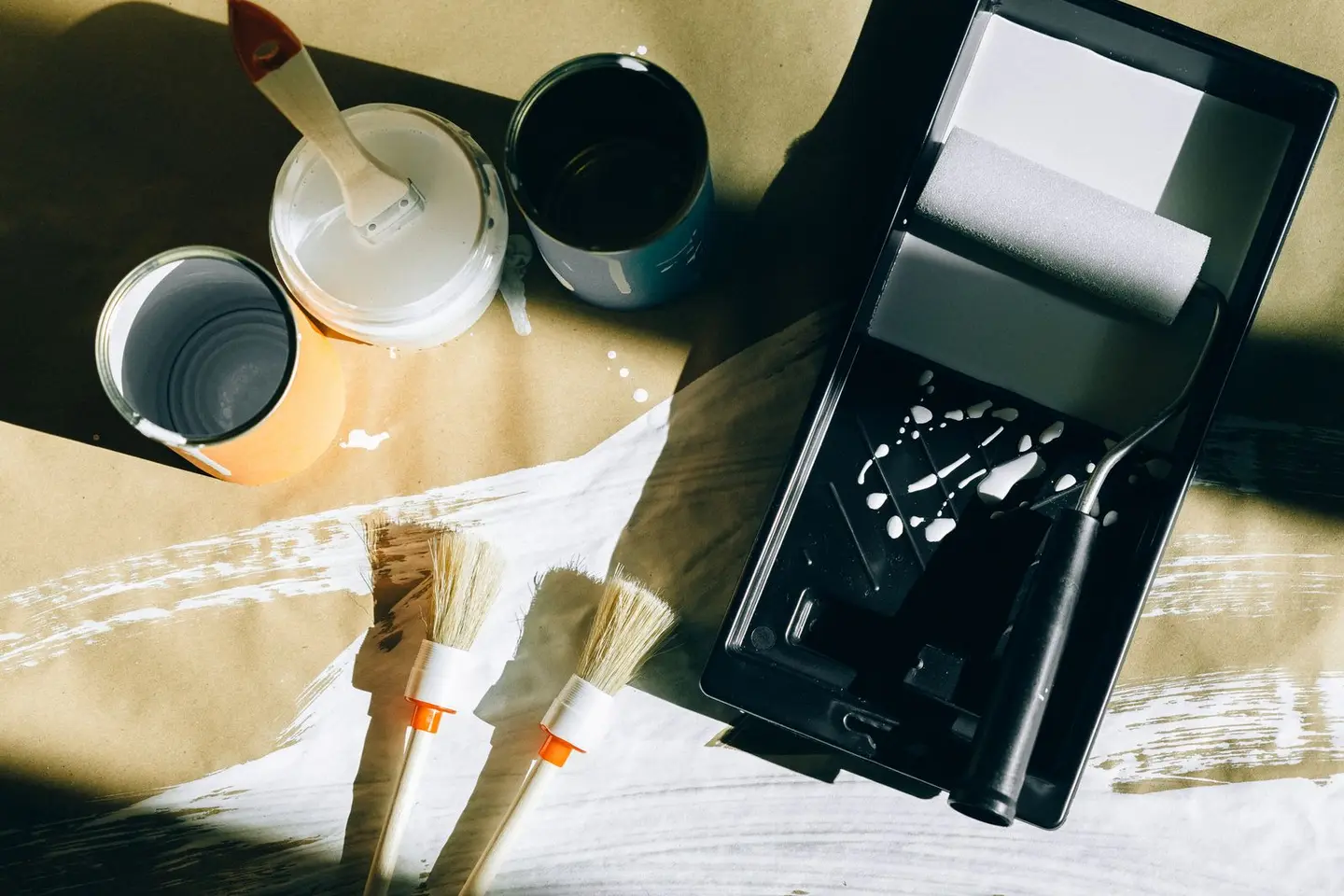
Running out of paint mid-wall, or ending up with four leftover tins, is easily avoided with a straightforward calculation. The key figures are your room’s surface area and the coverage rate printed on the paint tin. Once you have both, the maths takes about two minutes.
This guide walks through the method room by room, with worked examples for walls, ceilings, and woodwork, plus adjustments for porous new plaster and dark colour changes.
Coverage Rates by Paint Type
Coverage rates vary by product quality and surface porosity. Here are realistic figures for UK residential use:
| Paint Type | Coverage Rate (per litre) | Notes |
|---|---|---|
| Contract/flat matt emulsion | 10–12 m² | Low cost, less scrub-resistant |
| Vinyl matt emulsion (standard) | 11–14 m² | Most common wall paint |
| Silk / soft sheen emulsion | 12–15 m² | Slightly better coverage |
| Eggshell (water-based) | 12–16 m² | Woodwork and walls |
| Satin wood (water-based) | 10–12 m² | Doors, skirting, architraves |
| Gloss (water-based) | 10–12 m² | Woodwork, exterior |
| Masonry paint | 5–8 m² | Textured render absorbs more |
| Primer / mist coat | 8–12 m² | New plaster needs more coats |
Those are working figures for a real room, and they sit deliberately below what the tin claims. The manufacturer’s number is a best case on a sound, non-porous, uniformly coloured surface. For comparison, Dulux Trade quotes up to 18 m² per litre for Supermatt and up to 17 m² per litre for Vinyl Matt, and both figures carry the qualifier “on sealed surfaces”.12 On woodwork the published figures are lower and closer to what you actually get: up to 16 m² per litre for Diamond Eggshell, up to 12 m² per litre for Diamond Satinwood, and up to 12 m² per litre for water-based Quick Dry Gloss.1 Treat any figure above the manufacturer’s own as impossible rather than optimistic.
Premium paints at the higher end of a price range tend to offer better coverage per litre due to higher pigment concentration. Always check the coverage rate on your specific tin, manufacturers publish this on the label and on their website.
Step-by-Step: Calculating Paint for Walls
1. Measure wall height and perimeter
Measure floor-to-ceiling height and the perimeter (total distance around the room). Multiply them:
Wall area = perimeter × height
For a room 4 m × 3.5 m with 2.4 m ceilings:
Perimeter = (4 + 3.5 + 4 + 3.5) = 15 m
Wall area = 15 × 2.4 = 36 m²
2. Subtract doors and windows
Each standard interior door (roughly 2.0 m × 0.8 m) = 1.6 m²
A typical window (1.2 m × 1.0 m) = 1.2 m²
If your room has one door and one window:
36 − 1.6 − 1.2 = 33.2 m² paintable wall area
3. Divide by coverage rate and multiply by coats
For a vinyl matt emulsion at 12 m²/litre, two coats:
(33.2 ÷ 12) × 2 = 5.5 litres
Round up to the nearest tin size: 5.5 litres means a 5-litre tin plus a 1-litre tin, which leaves a little over for touching up later.
Ceiling Calculation
Ceiling area is simply length × width:
For a 4 m × 3.5 m room: 4 × 3.5 = 14 m²
Using a ceiling white matt at 12 m²/litre, two coats:
(14 ÷ 12) × 2 = 2.3 litres
A 2.5-litre tin covers this comfortably.
Woodwork: Doors, Skirting & Architraves
Woodwork areas are smaller but require primer plus two topcoats in most cases, so the total paint usage adds up.
A standard interior door (both sides, including edges): approximately 3.2–3.5 m² of surface. The common UK internal leaf is 1,981 × 762 mm, which is 1.5 m² a face.3 That is the old imperial 6 ft 6 in × 2 ft 6 in size; BS 4787-1 covers the metric door sizes instead.4
At 14 m²/litre for eggshell, two coats: 0.5 litres per door.
Skirting board: roughly 0.12 m² per linear metre (100 mm skirting painted front and top).
A 15 m perimeter room = about 1.8 m² of skirting.
At 14 m²/litre, two coats: about 0.3 litres, a 500 ml tin or sample pot typically suffices.
Architraves: approximately 0.08–0.1 m² per linear metre (face and edge).
One doorset (both sides, roughly 10 m total) = 0.8–1.0 m².
For a room like this, a 1-litre tin of eggshell or satin just about covers two topcoats on all the woodwork (roughly 0.5 + 0.3 + 0.1 litres, about 0.9 litres); buy a 2.5-litre tin if there is more than one door.
Worked Example: A Typical UK Living Room
| Element | Dimensions | Area | Coats | Litres Needed |
|---|---|---|---|---|
| Walls (less door + window) | 15 m perimeter × 2.4 m | 33.2 m² | 2 | 5.5 L |
| Ceiling | 4 × 3.5 m | 14 m² | 2 | 2.3 L |
| 1 door (both sides) | - | ~3.3 m² | 2 | 0.5 L |
| Skirting | 15 m run | ~1.8 m² | 2 | 0.3 L |
Total paint to buy: 5.5 L walls (purchase a 5 L and a 1 L tin) + 2.3 L ceiling (purchase a 2.5 L tin) + 1 L woodwork tin.
When to Add Extra Paint
New plaster is porous and soaks up paint. The first coat, the mist coat, is mostly absorbed, so you will use significantly more. Dilute it more heavily than most people expect: Dulux Trade tells you to seal new or bare surfaces with a first coat of Supermatt thinned with up to 1 part clean water to 3 parts paint.1 Add 25–35% extra for new plaster, or plan for three coats rather than two.
Covering a dark colour (dark grey, strong red, deep navy) with a pale colour is notoriously inefficient. Two coats of a standard white matt often fail to hide a deep colour. Options:
- Use a specialist stain-blocking primer first, one coat can save you a coat of topcoat
- Choose a paint with a higher opacity rating (check the spreading rate on the tin; a lower m²/litre often means denser coverage)
- Plan for three coats and budget accordingly
Rough or textured surfaces (pebbledash, artex, rough render) absorb significantly more paint than smooth plaster. For heavily textured masonry, halve the standard coverage rate to get a realistic estimate.
Paint Tin Sizes and Buying Strategy
Standard UK paint tin sizes are: 500 ml, 750 ml, 1 L, 2.5 L, 5 L, and occasionally 10 L for trade products. Buying the right size avoids waste but also keeps you from running short.
Rule of thumb: always round up to the next tin size, not down. Running out mid-wall and buying a second small tin risks a colour variation between production batches, which can be visible on the wall. Dulux Trade’s own advice for Supermatt is to buy enough tinted paint for each job at one time and from the same source.5
If you are ordering a mixed colour, buy all the paint you need in one order. Mixed colours are difficult to match exactly if you need more later.
Leftover paint can be stored with a tight-fitting lid in a frost-free location for two to three years. Note the room name, colour reference, and purchase date on the lid with a permanent marker.
Common Calculation Mistakes
- Forgetting to account for two coats, the single most common underestimate
- Ignoring ceilings, they add up quickly in large rooms
- Not subtracting doors and windows, makes little difference in a window-heavy room but can lead to over-buying
- Using the tin’s maximum coverage figure, manufacturers quote best-case figures on smooth surfaces; real-world coverage is often 20–40% lower, as the working figures in the table above show
- Buying a single 10-litre tin to save money, this only makes sense if you are painting a very large area in one go; leftover paint in a large tin deteriorates faster once opened
With a tape measure, a calculator, and the coverage rate from your chosen tin, the whole calculation takes five minutes and can save you two extra trips to the merchant.
References (5)
Figures in this note were checked against the sources below on 30 September 2026. Superscript numbers in the text point to them. Every source the site cites, by topic.
- 1technicalsupplier figureDulux Decorator Centre.RN-4IVU75One document carrying the published coverage figure for the whole Dulux Trade range, which is what a paint quantity note needs instead of a retailer page. Every emulsion figure is qualified 'on sealed surfaces': Supermatt up to 18 m2 per litre (datasheet 410, pack sizes 5L and 10L, recoat 2 to 4 hours), Vinyl Matt up to 17 m2 per litre, Diamond Matt up to 17, Diamond Eggshell up to 16 m2 per litre, Evolve Matt up to 17. Trim products are lower and unqualified: Diamond Satinwood up to 12 m2 per litre (datasheet 1006, packs 1L, 2.5L, 5L, recoat 6 hours), Quick Dry Gloss up to 12 m2 per litre (datasheet 550, packs 1L, 2.5L, 5L, recoat 6 hours), Quick Dry Undercoat up to 10 m2 per litre. Colour Sampler is 250 ml covering up to 2 m2. It also prints the Supermatt thinning ratios: sealing new or bare surfaces add up to 1 part clean water to 3 parts paint, airless spray up to 1 part water to 5 parts paint, conventional spray up to 1 part water to 2.5 parts paint. Useful ceiling: any guide quoting more than 12 m2 per litre for a water-based gloss or satinwood is quoting more than the manufacturer does.
- 2technicalsupplier figureDulux Trade (AkzoNobel), a data sheet.RN-VJKBDPManufacturer specifier guide with the numbers behind a how-much-paint calculation. Coverage is quoted at 18 m2 per litre for Diamond Matt, 17 m2 per litre for Vinyl Matt, and 16 m2 per litre for the other two grades in the comparison table, so a 5 litre tin covers roughly 85 m2 in one coat and a two coat job on a 40 m2 room needs about 5 litres. Scrub resistance is Scrub Class 5 on the top grade against Scrub Class 2 on Vinyl Matt, both Class 1 to ISO 11998 and Type C to BS 7719. Dulux Trade Vinyl Matt is stated to be 99.9 per cent VOC free based on in-can VOC content measured to ISO 11890-2:2013, and the guide shows measured VOC emissions in mg/m3 against the BREEAM TVOC threshold of less than or equal to 1.0 mg/m3. For airless spraying the guide specifies a 515 or 517 tip at 1300-1700 psi (89-117 bar). The manufacturer notes coverage is a guideline only and varies with equipment, substrate and application.
- 3technicalsupplier figureJELD-WEN UK, guidance.RN-LQJT0UA JELD-WEN UK internal door product page listing its module sizes, which include the standard 1,981 × 762 mm leaf.
- 4technicalstrongBSI (British Standards Institution), a standard.RN-U9PCSGSTATUS: CURRENT, with no withdrawal date shown despite the 1980 date. BS 4787-1:1980 was published 30 June 1980 and specifies the metric sizes for dimensionally coordinated internal and external wood doorsets, door leaves and frames, that is the work sizes for the doorset as an assembly of fixed frame plus movable leaf with its hardware, with information on glazed openings and ancillary provisions in Appendix A, and it is written to coordinate doors with windows. This is the origin of the standard UK metric door sizes (762 x 1981 mm and its relatives) that a note quotes when telling a reader whether a replacement leaf will fit an existing lining. Note that performance, as distinct from dimensions, comes from other standards: BS EN 14351-1 for external pedestrian doorsets and BS 8214 for timber fire door assemblies. Catalogue page confirms number, title, date, status and scope; the size tables are paywalled.
- 5technicalsupplier figureDulux Trade (AkzoNobel), guidance.RN-B1TLQKThe maker's product page for Dulux Trade Supermatt, including its application notes and the advice on buying tinted paint for colour consistency.
-
Dulux Trade Professional Products Guide, Dulux Decorator Centre, accessed 9 September 2026. duluxdecoratorcentre.co.uk
-
Dulux Trade Vinyl Matt specifier guide, Dulux Trade (AkzoNobel), accessed 9 September 2026. duluxdecoratorcentre.co.uk
-
Atherton 4 Panel interior door, JELD-WEN UK, accessed 30 September 2026. jeld-wen.co.uk
-
BS 4787-1:1980 Internal and external wood doorsets, door leaves and frames. Specification for dimensional requirements, BSI, accessed 9 September 2026. knowledge.bsigroup.com
-
Dulux Trade Supermatt, Dulux Trade (AkzoNobel), accessed 30 September 2026. duluxtradepaintexpert.co.uk