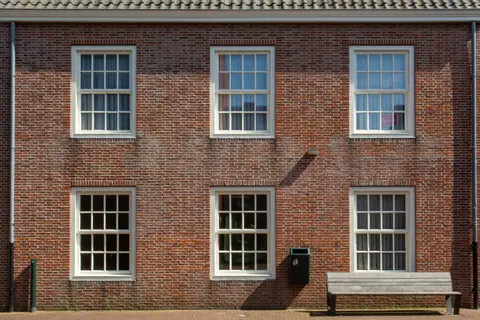
A professional window cleaner will do a better job than most householders can manage from the ground, particularly for first-floor windows and awkward bay or skylight glazing. A typical three-bed semi costs roughly £10–£25 a visit on a monthly round, making regular professional cleaning one of the most cost-effective maintenance tasks you can outsource.
For most domestic properties, hiring a window cleaner is straightforward: prices are quoted per visit, rounds run fortnightly or monthly, and payment is typically cash or bank transfer left at the end of the month. This guide covers what to expect, how to compare quotes, and what to check before you let anyone near your property.
What Does a Professional Window Cleaner Do?
A standard domestic window-cleaning visit covers:
- All external window panes (glass only, not frames unless specified)
- Ground-floor and first-floor windows using a water-fed pole or traditional squeegee method
- Conservatory roofs and skylights if agreed in advance (usually extra charge)
- UPVC frames and sills wiped down on a full-clean service
Many window cleaners now use a water-fed pole (WFP) system rather than ladders for ground and first-floor work. Purified water is pumped through a telescopic pole and brush head; because it contains no dissolved minerals, it leaves no spotting as it dries. Second and third-floor windows may still require ladders or a cherry picker on some properties.
Window Cleaning Costs by Property Type
Prices vary by region, frequency, and whether frames are included. The figures below are rough 2026 per-visit prices for a regular round in England.
| Property type | Per visit (glass only) | Per visit (glass + frames) |
|---|---|---|
| Terraced house (2-bed) | £6–£10 | £10–£16 |
| Semi-detached (3-bed) | £10–£18 | £16–£25 |
| Detached (4-bed) | £20–£40 | £30–£55 |
| Bungalow | £8–£14 | £12–£20 |
| Conservatory roof (add-on) | £10–£25 | - |
| Velux/skylight (per unit) | £3–£8 | - |
Prices in London and the South East typically sit above the ranges shown here. Rural areas and the North of England tend to come in at the lower end.
Per-Pane vs Per-Property Pricing
Some cleaners quote per pane; others quote per property. As a rough cross-check:
- Per pane: rates depend on pane size and access
- Per property: as above table
- A standard 3-bed semi has roughly 14–20 panes, so the semi-detached round prices above work out at roughly 50p to £1.80 a pane; a per-pane quote well above that is worth questioning
One-off cleans usually cost more than ongoing round work. If you want a one-off before selling or after building work, expect to pay 30–50% more than the round rate.
How Often Should Windows Be Cleaned?
The British climate, rain, airborne dust, pollen, and exhaust particulates, means windows get dirty quickly. General guidance:
- Urban and roadside properties: every 4 weeks
- Suburban homes: every 4–8 weeks
- Rural properties: every 8–12 weeks (fewer pollutants but more mud splash and algae)
- Coastal homes: every 2–4 weeks (salt spray accelerates spotting)
Many cleaners offer fortnightly, monthly, or bi-monthly rounds. Quarterly visits are available but windows will need a heavier initial clean if they have been left more than three months.
DIY vs Professional Window Cleaning
For ground-floor windows on a single-storey property, DIY is perfectly viable with a good squeegee and chamois leather. The calculus shifts when:
- You have first-floor or higher windows requiring a ladder
- You have a bay window, dormer, or conservatory roof
- You lack the time or mobility to do it safely
- You want consistent results without streaks
Working from ladders at height carries real risk. The Work at Height Regulations 2005 apply to professional contractors but the principle, that ladder use should be avoided where a safer alternative exists, is equally relevant at home. A water-fed pole removes most of the ladder risk on typical domestic jobs of up to three or four storeys.
Water-Fed Pole vs Traditional Method
| Feature | Water-fed pole (WFP) | Traditional (squeegee + ladder) |
|---|---|---|
| Access height | Up to 3–4 storeys from ground | Ladder required above ground floor |
| Ladder use | None for most domestic jobs | Required for upper floors |
| Finish | Pure water dries spot-free | Relies on technique; can streak |
| Frame cleaning | Limited without additional wipe | Good with a chamois |
| Cost | No difference to customer | No difference to customer |
| Risk profile | Lower | Higher (ladder fall risk) |
The WFP method uses purified (deionised or reverse-osmosis) water. Some customers worry that windows look smeary immediately after, this is normal; the water soon dries clear on a dry day.
Typical Day Rates for Window Cleaning Sole Traders
Most domestic window cleaners are self-employed sole traders or small partnerships. A typical operative running a full domestic round in 2026 expects to earn:
- Day rate (effective): £180–£350 per day depending on density of round and location
- Hourly rate equivalent: £22–£45/hour
- One-off jobs: charged at a premium; minimum call-out often £20–£30
Window cleaning rounds are priced for speed and efficiency. A cleaner doing 15–20 houses per day at £15 per house is earning £225–£300 for a day’s work, covering fuel, equipment maintenance, and public liability insurance.
How to Vet a Window Cleaner
There is no licensing scheme for window cleaners in England, so due diligence falls to you. Scotland is different: the Civic Government (Scotland) Act 1982 provides for a window cleaner’s licence, which councils there administer.1
Ask about insurance Any professional window cleaner working on residential property should carry public liability insurance, and the Federation of Window Cleaners requires it of its members.2 Cover of £1m to £5m is common. Ask to see the certificate or the insurer’s name and policy number. This protects you if a window is broken, a ladder slips and damages guttering, or purified water leaks through an open fanlight.
Check references and reviews Ask neighbours who they use, or check Google Business and Checkatrade reviews. A cleaner who has been running the same local round for several years is lower risk than an unknown one-off.
Clarify the scope Before the first visit, agree in writing (text or email is fine) what is included: glass only or frames; how many windows; whether the conservatory roof or Velux units are included; and at what extra cost.
Payment terms Reputable window cleaners do not ask for upfront payment. Payment after each visit, cash, BACS, or payment app, is standard. Be cautious of anyone asking for several months’ fees in advance.
Insurance and Liability
If a window cleaner damages your property, their public liability insurance should cover the repair. However:
- Check the policy is current before they start
- Photograph any pre-existing cracks or chips so there is no dispute later
- If a window breaks during cleaning, get it in writing before anyone leaves
If a window cleaner is injured on your property, their own insurance is the first place to look. You are not the employer of a self-employed contractor, but your home insurance may include liability cover for people working at your home, so check your policy.
Regulations: Working at Height
The Work at Height Regulations 2005 require employers and those in control of work at height to make sure it is properly planned, supervised and carried out by competent people.3 For professional window cleaners this means:
- Work at height should be avoided where reasonably practicable, for example by using telescopic water-fed poles3
- A ladder should not be the automatic choice, but can be the most sensible option for low-risk, short-duration tasks, and should be checked for defects and tied where possible3
- Water-fed poles avoid the need for ladders on most domestic jobs
Health and safety law also applies to self-employed window cleaners if their work exposes others to risk; the duties fall on the contractor, not on you as the homeowner.3 However, if you are hiring someone who routinely uses a ladder without stabilisers or footing, particularly on soft ground, that is a risk indicator worth noting.
Finding a Window Cleaner
- Ask neighbours: most cleaners work rounds, so your neighbour’s cleaner may already pass your street
- Federation of Window Cleaners (FWC): a UK trade association for window cleaners; members agree to follow its code of practice2
- Checkatrade and Rated People: useful for one-off cleans; less common for regular rounds
- Local Facebook groups: often the fastest way to find who is already working in your area
Avoid leaflet-only operators with no traceable online presence; a legitimate round cleaner will have a local reputation you can check.
References (3)
Figures in this note were checked against the sources below on 30 September 2026. Superscript numbers in the text point to them. Every source the site cites, by topic.
- 1technicalvery strongThe National Archives, guidance.RN-GD90K2Section 43 of the Civic Government (Scotland) Act 1982. It creates the window cleaner's licence required to carry on the trade in Scotland, administered by local licensing authorities.
- 2technicalvery strongFederation of Window Cleaners, guidance.RN-JY5PIDThe Federation of Window Cleaners' rule book and code of practice, as filed with the Certification Officer. It requires members to hold public liability insurance and employer's liability where appropriate.
- 3technicalvery strongHealth and Safety Executive, guidance.RN-7FFIB1HSE's guidance sheet for the window cleaning trade, the source behind the questions a homeowner should ask before hiring one. It applies the Work at Height Regulations 2005 hierarchy: avoid work at height where reasonably practicable, for example by using telescopic water fed poles or cleaning from inside; then use an existing safe place of work such as an inside sill or balcony; then minimise the consequences of a fall. It names the joint HSE and Federation of Window Cleaners best practice guidance 'Window Cleaning with Water Fed Poles: How to do it and look after your body'. On ladders it says a ladder should not be the automatic choice but can be the most sensible option for low risk, short duration tasks, traditionally ground, first and second floor domestic windows, that almost all falls from ladders happen because the ladder moved unexpectedly, and that the ladder should be tied to a suitable point wherever possible. The Regulations require work at height to be properly planned, supervised and carried out by competent people. Cite this for why a quote based on water fed poles is the safer and normal method above ground floor.
-
Civic Government (Scotland) Act 1982, section 43: Window cleaners’ licences, The National Archives, accessed 30 September 2026. legislation.gov.uk
-
Federation of Window Cleaners: Rules and Code of Practice, Federation of Window Cleaners, accessed 30 September 2026. assets.publishing.service.gov.uk
-
Working at height whilst window cleaning, Health and Safety Executive, accessed 30 September 2026. hse.gov.uk