An Energy Performance Certificate (EPC) rates how energy-efficient your home is on a scale from A (most efficient) to G (least efficient). You must have a valid EPC to sell or let a property in England, Wales or Scotland, and you must order it before the property is marketed.1 The certificate shows your current band, a potential band if you made recommended improvements, and estimated annual energy costs.
The typical home sits at the top of band D: homes in England had a median EPC score of 68, and homes in Wales 67, across certificates lodged in the ten years to March 2024.2 If you are selling or letting, your EPC band is shown to every buyer or tenant, and grant schemes such as the Boiler Upgrade Scheme have their own eligibility rules, so check what help you qualify for.
How the EPC Score Is Calculated
The score typically runs from 1 to 100 SAP (Standard Assessment Procedure) points.2 The band boundaries are:
| Band | SAP Points |
|---|---|
| A | 92 plus |
| B | 81–91 |
| C | 69–80 |
| D | 55–68 |
| E | 39–54 |
| F | 21–38 |
| G | 1–20 |
The certificate also estimates the home’s typical energy costs, which depend on its size and heating system as well as its band.1
The SAP calculation takes account of wall and roof insulation levels, window glazing, heating system efficiency, hot water provision, lighting, renewable generation, and air tightness. Each element is weighted; improvements to a poorly rated element give the biggest score gain.
Who Can Carry Out an EPC Assessment
Only an accredited domestic energy assessor (DEA) can issue a valid EPC. You can find one through the government’s find an accredited assessor service.1 Fees run from around £60–£120 for a standard home; larger or more complex properties may cost £150 or more. The certificate is valid for ten years, so there is no need to renew it unless you make significant changes and want the score updated.1
EPC Requirements for Landlords
The minimum EPC E requirement for privately rented homes in England and Wales has applied to new and renewed tenancies since 1 April 2018 and to all existing tenancies since 1 April 2020.3 The government’s stated aim is for as many privately rented homes as possible to reach EPC band C or equivalent by 2030, but the detailed rules had not been confirmed by September 2026.3
Landlords in breach of the minimum standard can be fined up to £5,000 per property.3 The cost cap for mandatory improvements is currently set at £3,500 including VAT; beyond that threshold a landlord may register an exemption.3
Most Cost-Effective Ways to Improve Your EPC
Loft Insulation (D→C Potential)
Current guidance recommends at least 270 mm of mineral-wool quilt in a loft, and insulating an empty loft to that depth is one of the cheapest measures an EPC can recommend.4 The Energy Saving Trust puts the installed cost at about £750 starting from no insulation, or about £600 to top up from 120 mm.4 Almost every EPC recommends loft insulation for homes without it.
Cavity Wall Insulation (D→C or C→B Potential)
Cavity-fill insulation (mineral wool or EPS bead) is injected from outside, and for an average home with easy-to-access walls the job usually takes about two hours.5 The Energy Saving Trust puts the cost for a typical home in Great Britain at around £2,200.5 It is not suitable where the cavity is narrower than 50 mm or the walls are exposed to driving rain (check the product’s third-party certificate for suitability).5 UKAS suspended the BBA’s accreditation on 26 February 2026, so no new accredited BBA certificates are being issued while that stands, though one issued before that date remains valid and certification from another UKAS-accredited body, or a European Technical Assessment, counts for the same.6
Draught-Proofing and Sealed Letter Boxes
A low-cost measure (£80–£200 DIY to professional fit) that improves air tightness and contributes modestly to SAP points while reducing heating bills.
Upgrading the Boiler
Replacing an old non-condensing boiler with a modern condensing unit can add a useful number of SAP points on its own. A new gas combi costs £2,000–£3,500 fitted; an oil boiler replacement, £3,000–£5,000. Factor in the potential of switching to a heat pump instead (see below) which scores even higher.
Heat Pump (B or Above)
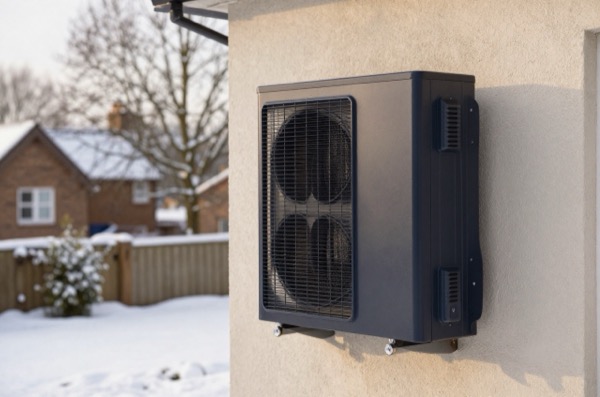
Air source heat pumps typically achieve a Seasonal Coefficient of Performance (SCOP) of around 2.5–3.5, producing that many units of heat for every unit of electricity consumed. This usually lifts the heating element of the SAP score. The Energy Saving Trust puts the typical installed cost at around £12,000 (before grant; Boiler Upgrade Scheme grant in England and Wales: £7,500).7 Until March 2027 homes heated by oil or LPG with no mains gas connection can get an extra £1,500.8 Suitability depends on adequate wall/roof insulation and suitable heat emitters (underfloor heating or large radiators).
Solar Photovoltaic Panels
A 4 kWp roof array typically generates roughly 3,400–3,800 kWh a year in southern England, less in Scotland. The SAP calculation credits renewable generation against consumption. The Energy Saving Trust puts a typical 4.5 kWp system at around £7,600 installed.9 It puts battery storage at around £5,000 to £8,000.9 The EPC score improvement depends on the baseline rating and the size of the array.
Double or Triple Glazing
Old single-glazed windows typically have a U-value of around 4.8–5.5 W/m²K. A replacement window must reach 1.4 W/m²K or better, or Window Energy Rating band B, under Approved Document L.10 Triple glazing can reach roughly 0.6–0.8 W/m²K. Replacing single with double glazing typically adds a few SAP points, depending on glazing area. Cost: £4,000–£12,000 for a whole house, depending on number and size of windows. Replacing the windows of a listed building needs listed building consent, and in some conservation areas an Article 4 Direction means planning permission is needed too.11
Prioritising Improvements for Maximum SAP Gain
Focus on the measures your EPC already recommends, they are ranked by impact for your specific home. As a rule of thumb:
- Insulation first (loft, cavity, solid wall if applicable), biggest gains per pound
- Heating system upgrade, boiler or heat pump
- Hot water, solar thermal or heat pump hot water cylinder
- Renewables, solar PV, potentially with battery
Solid-wall insulation is significantly more expensive: the Energy Saving Trust puts a typical three-bedroom semi at around £12,000 for internal and £15,000 for external insulation.12 It may be the main wall option for pre-1920 homes, which are more likely to have solid walls.5 The Great British Insulation Scheme closed on 31 March 2026, so check ECO4 eligibility or local authority grants before paying full cost.13
Getting a Reassessment After Improvements
Once work is complete, commission a new EPC from your DEA. Bring invoices, FENSA or Competent Persons certificates, and any product data sheets. The assessor will inspect and update the rating. Costs are the same as a first-time assessment (£60–£120). A higher band may help a sale, but estimates of any price premium vary widely, and location and condition matter more.
Sell or Let With a Better Rating
Updating your EPC before marketing can be a low-cost way to present your home more favourably. Even a one-band improvement, such as E to D, looks better on portals.
Building Regulations and Standards
Works that change the fabric of the building (new windows, insulation upgrades) may require Building Regulations approval to comply with Approved Document L (Conservation of Fuel and Power).10 Most reputable installers self-certify under a Competent Person Scheme: FENSA and others for replacement windows, and schemes such as CERTASS, Certsure, NAPIT or the Installation Assurance Authority (IAA) for cavity wall insulation.14 Always ask for the certificate, because a buyer’s solicitor will usually ask to see it when you sell.
References (14)
Figures in this note were checked against the sources below on 2 October 2026. Superscript numbers in the text point to them. Every source the site cites, by topic.
- 1technicalvery strongGOV.UK, guidance.RN-L2XXSXAn EPC is required before a property is marketed for sale or rent and is valid for 10 years, rating the property from A at best to G at worst. Exemptions include temporary buildings in use for less than two years, stand-alone buildings under 50 square metres, industrial sites and non-residential agricultural buildings with low energy use, buildings due for demolition, holiday lets used for under four months a year, residential buildings occupied for less than four months a year, places of worship, and listed buildings where compliance would unacceptably alter their character or appearance. A fine applies where an EPC is required and not obtained. Assessors are found through the find an accredited assessor service.
- 2technicalvery strongOffice for National Statistics, guidance.RN-RST0J6ONS analysis of EPC records for the ten years to March 2024: median score 68 in England and 67 in Wales, both band D, with the SAP band boundaries listed.
- 3technicalvery strongDepartment for Energy Security and Net Zero (GOV.UK), a government page.RN-B5QOYUThe current statutory floor on rented-property energy work, and the source of the £3,500 figure that governs landlord retrofit budgets. Since 1 April 2020 a landlord cannot let or continue to let a domestic property with an EPC rating below band E unless a valid exemption is registered. The cost cap is £3,500 including VAT: a landlord who has spent that much without reaching band E can register a high cost exemption. Exemptions and their durations: all relevant improvements made, 5 years; high cost, 5 years; wall insulation where the required measure would damage the property, 5 years; third party consent refused, 5 years, or until the tenancy ends where it was tenant consent that was withheld; property devaluation of 5% or more, 5 years; and recently becoming a landlord, 6 months. Every exemption must be registered on the PRS Exemptions Register before letting. Penalties per property per breach: up to £2,000 for renting out a non-compliant property for less than 3 months, up to £4,000 for 3 months or more, up to £1,000 for false or misleading register information, and up to £2,000 for failing to comply with a compliance notice, capped at £5,000 in total per property.
- 4technicalfairEnergy Saving Trust, guidance.RN-I69XGOEnergy Saving Trust's consumer advice page on roof and loft insulation: recommended depths, the difference between insulating at joist level and at rafter level, and indicative costs and savings. EST is a consumer-facing body rather than the authority for the depth, so it is cited for the plain explanation and Approved Document L is cited for the requirement. The page blocks automated fetching, so it is described here from its title and publisher.
- 5technicalfairEnergy Saving Trust, guidance.RN-54KWR6How to identify a cavity wall and what filling it costs. About 33% of all heat lost from an uninsulated home escapes through the walls. Houses built after the 1920s usually have cavity walls; pre 1920 houses are usually solid; houses from the 1990s onwards usually already have wall insulation. Identification: cavity walls show an even stretcher bond with all bricks laid lengthways, solid walls show an alternating pattern with header ends visible; a brick wall 260mm to 350mm thick is likely a cavity wall, narrower is likely solid, stone walls are solid up to about 500mm thick and earth walls run 300mm to over a metre. Typical installed cost around £2,200 in Great Britain and around £1,000 in Northern Ireland, with payback usually five years or less. Unsuitable where the wall is exposed to extreme weather or flooding, in poor condition, at risk of overheating, or where the cavity is narrower than 50mm. External repairs to brickwork, pointing, roofs, gutters and downpipes must be completed first or damp can be trapped. Underfloor grilles, airbricks, wall vents and trickle vents must not be blocked. Post installation damp is chased through the installer, then the Cavity Insulation Guarantee Agency guarantee or an independent insurance backed guarantee.
- 6technicalstrongUnited Kingdom Accreditation Service.RN-BNGAIDThe live UKAS register of accredited bodies currently under sanction. It records the British Board of Agrement under imposed suspension from 26 February 2026 across all four of its accreditations: ISO/IEC 17065 product certification and ISO/IEC 17021 management systems under reference 0113, ISO/IEC 17020 inspection under 4345, and ISO/IEC 17025 testing under 0357. This is the page to check before repeating any advice that treats a BBA certificate as accredited third party assurance.
- 7costfairEnergy Saving Trust.RN-X9NXFYA price, true at 2026-09. Energy Saving Trust advice page on air source heat pumps, giving the typical installed cost for a UK home.
- 8technicalvery strongGOV.UK.RN-9EFNVZThe grant values: £7,500 towards an air source heat pump, £7,500 towards a ground source heat pump including water source heat pumps and those on shared ground loops, and £5,000 towards a biomass boiler. A further £1,500 is available until March 2027 where the property is heated by oil or LPG and has no mains gas connection. Only one grant is available per property. Capacity limits are 45kWth for an individual system, 70kWth for multiple heat pumps and 300kWth for shared ground loops. Hybrid systems pairing a gas boiler with a heat pump are not eligible, and an existing low carbon heating system cannot be replaced under the scheme.
- 9costfairEnergy Saving Trust.RN-AQ9M8VA price, true at 2026-09. Energy Saving Trust solar PV guidance: a typical domestic system is about 4.5 kWp and costs around £7,600 installed.
- 10technicalvery strongMinistry of Housing, Communities and Local Government.RN-L0FCJXThe in-force U-value tables a DIY insulation or door note must quote, with the exact numbers. Table 4.2, limiting U-values for new fabric elements in existing dwellings, sets roof 0.15, wall 0.18, floor 0.18, swimming pool basin 0.25, window 1.4 or Window Energy Rating Band B minimum, rooflight 2.2, doors with more than 60 per cent of the internal face glazed 1.4 or Doorset Energy Rating Band C minimum, and other doors 1.4 or Doorset Energy Rating Band B minimum. Table 4.3, for existing elements, gives a roof threshold of 0.35 and an improved value of 0.16, which is the figure a loft insulation note needs: paragraph 4.12 says a retained element whose U-value is higher than the column (a) threshold, for example through a loft or garage conversion, should be upgraded to the column (b) value. Paragraph 4.13 allows a lesser upgrade only where the improved value is not technically or functionally feasible or would not achieve a simple payback of 15 years or less. Paragraph 4.8 requires a replacement element to be no worse than the one it replaces as well as meeting Table 4.2. Paragraph 4.10 gives the heritage exception: where character must be maintained, a centre pane U-value of no more than 1.2 or low-emissivity secondary glazing. Note 9 records that the timber window concession of 1.6 or Band C ended on 14 June 2023. The 2021 edition came into force on 15 June 2022; a 2026 edition exists at https://assets.publishing.service.gov.uk/media/69c122a6cfa346b9d4704a55/ADL1_2026.pdf.
- 11technicalvery strongHistoric England, guidance.RN-54XKD7Historic England's technical advice on improving the energy performance of historic windows without replacing them: draughtproofing, secondary glazing, shutters and repair, and what each does to heat loss. The relevant authority where a window is in a listed building or conservation area and replacement is not the default answer. The site blocks automated fetching, so it is described from its title and publisher.
- 12costfairEnergy Saving Trust, guidance.RN-RV8Z6HA price, true at 2026-09. Solid wall insulation costs and the quality problem. Typical installation £12,000 to £15,000, split as around £15,000 for external wall insulation and around £12,000 for internal. Around 33% of the heat lost from an uninsulated home goes through the walls. Homes built before 1920 are more likely to have solid walls, of brick, stone, earth or timber frame with panels. A registered installer should guarantee the work for 25 years, and any TrustMark solid wall insulation company offers a 25 year guarantee backed either by an insurer or through the Solid Wall Insulation Guarantee Agency. Records that in October 2025 the National Audit Office reported on quality failures in wall insulation under government schemes, and that 98% of homes fitted with external wall insulation under ECO4 and the Great British Insulation Scheme have problems needing fixing, with affected households sent an Ofgem letter carrying a Unique Measure Reference Number in early 2026 and a remediation line on 0333 555 1234 option 1.
- 13technicalvery strongOfgem.RN-RDOIJRThe scheme, formerly known as ECO+, ran from April 2023 to 31 March 2026 and is now closed. It obliged medium and large energy suppliers to deliver measures reducing energy use in the least energy-efficient homes in Great Britain. Eligibility was homes with an EPC rating of D to G in Council Tax bands A to D in England, or A to E in Scotland and Wales, plus low-income and vulnerable households. Unlike ECO4, which funds whole-house packages, GBIS mostly delivered a single insulation measure per home. This is the page to cite when a note has to say a grant route has closed rather than leave a reader chasing it.
- 14technicalvery strongMinistry of Housing, Communities and Local Government.RN-SAMO3MThe official list of competent person schemes whose members can self-certify certain building work instead of getting building regulations approval, published 4 April 2013 and last updated 12 March 2018. Named schemes with contact numbers include ATTMA, APHC, Assure Certification, Blue Flame Certification, the British Board of Agrement, BESCA, Capita Gas Registration and Ancillary Services trading as Gas Safe Register, CIGA, Certass, Certsure LLP trading as NICEIC, the Elmhurst Airtightness Scheme, Fensa Limited, HETAS Limited, NAPIT Registration Limited, the National Federation of Roofing Contractors trading as CompetentRoofer, and OFTEC. Two footnotes matter: the Gas Safe Register is not technically a competent person scheme although in practice its installers carry the same building regulations responsibilities, and Benchmark Certification Limited ceased to operate as a competent person scheme on 10 February 2017, becoming part of NAPIT Registration Limited that day. Installers joining an electrical scheme are added to the single electrical competent person register.
-
Buying or selling your home: Energy Performance Certificates, GOV.UK, accessed 30 September 2026. gov.uk
-
Energy efficiency of housing in England and Wales: 2024, Office for National Statistics, accessed 30 September 2026. ons.gov.uk
-
Domestic private rented property: minimum energy efficiency standard - landlord guidance, Department for Energy Security and Net Zero, accessed 30 September 2026. gov.uk
-
Roof and loft insulation, Energy Saving Trust, accessed 30 September 2026. energysavingtrust.org.uk
-
Cavity wall insulation, Energy Saving Trust, accessed 30 September 2026. energysavingtrust.org.uk
-
Organisations under sanction, United Kingdom Accreditation Service, accessed 7 September 2026. ukas.com
-
Air source heat pumps: costs, savings and benefits, Energy Saving Trust, accessed 30 September 2026. Priced at 2026-09 and left there. energysavingtrust.org.uk
-
Apply for the Boiler Upgrade Scheme: What you can get, GOV.UK, accessed 30 September 2026. gov.uk
-
Solar panels: costs, savings and benefits explained, Energy Saving Trust, accessed 30 September 2026. Priced at 2026-09 and left there. energysavingtrust.org.uk
-
Approved Document L, Conservation of fuel and power, Volume 1: Dwellings, 2021 edition incorporating 2023 amendments, Ministry of Housing, Communities and Local Government, accessed 14 September 2026. assets.publishing.service.gov.uk
-
Modifying historic windows as part of retrofitting energy-saving measures, Historic England, accessed 30 September 2026. historicengland.org.uk
-
Solid wall insulation, Energy Saving Trust, accessed 30 September 2026. Priced at 2026-09 and left there. energysavingtrust.org.uk
-
Great British Insulation Scheme, Ofgem, accessed 29 September 2026. ofgem.gov.uk
-
Competent person scheme: current schemes and how schemes are authorised, Ministry of Housing, Communities and Local Government, accessed 30 September 2026. gov.uk